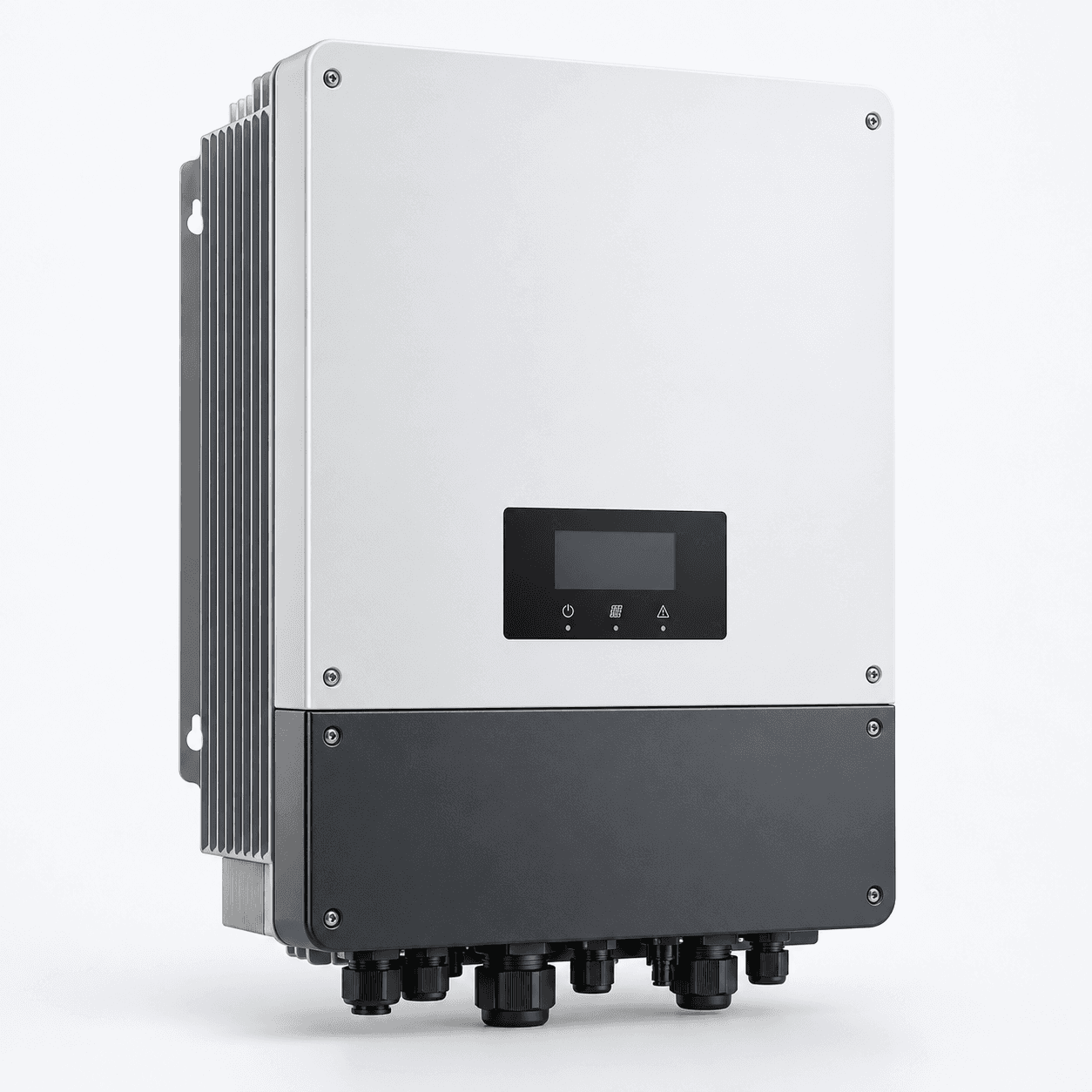
How to choose an inverter
An inverter has to satisfy the appliance, battery and installation at the same time. Continuous watts are only the first screening criterion.
Sources and methodology
Source-based desk research and explicit calculations; no hands-on testing claimed. Missing values remain unknown. Installation compatibility needs a separate assessment.
Continuous load and starting behaviour
List appliances that may run simultaneously. Compare that load against the inverter's continuous output at the expected ambient temperature, not only the headline maximum. Motors and compressors need a separate startup assessment. A surge claim without duration is incomplete: a few milliseconds of output is not equivalent to several seconds. Record whether overload recovery is automatic and what happens to connected electronics.
Choose the DC architecture
At 2000 W and 92% efficiency, nominal current is about 181 A at 12 V, 91 A at 24 V or 45 A at 48 V. These are illustrative values; use minimum operating voltage for the design check. Higher voltage can reduce current but requires compatible storage, charging and DC-rated protection. Never change bank voltage without checking every connected DC device.
Read the functions separately
Pure sine describes the output waveform. Inverter charger describes bidirectional roles; transfer or UPS describes source switching. One label does not imply all three. Check AC voltage and frequency, charger current, neutral-earth instructions, transfer delay and no-load draw. A larger inverter can waste more standby energy in a small system, so compare operating behaviour alongside power.
Worked case and decision
Suppose electronics consume 350 W and a pump consumes 500 W while running. Simultaneous continuous demand is 850 W. If the measured pump start requires 1800 W, the inverter may see about 2150 W during that event, with the electronics still operating. A 1000 W label alone cannot establish suitability. Ask for the overload curve, its duration and the rating at the installation temperature. Next check the battery: at 850 W and 92% efficiency, a 12.8 V source supplies roughly 72 A at nominal voltage, and more at low voltage. The startup current is a separate battery constraint. If the proposed system fails either check, consider an appropriately rated inverter and battery architecture, or permitted load sequencing. Do not treat a bigger inverter as a cure for an undersized DC supply. Include standby consumption in the energy budget.
Turn the explanation into a procurement brief
Record included and excluded loads, system voltage, simultaneous power, starting demand and required duration. Keep efficiency and seasonal assumptions beside the result. Compare only documented values for the exact model; a missing catalog field means it needs verification, not that a feature exists. Ask the supplier for the manual, Romania delivery terms and warranty procedure before ordering.
After selecting components, a qualified installer should verify cables, protection, source isolation, ventilation and site conditions. Do not use a worked energy example as wiring instructions. When changing a load or battery, revisit both the energy budget and power check. A supervised operating test should confirm assumptions without exceeding manufacturer limits.
Sources and technical reading
Independent editorial explanation. Numerical examples are illustrative calculations, not specifications attributed to a product.