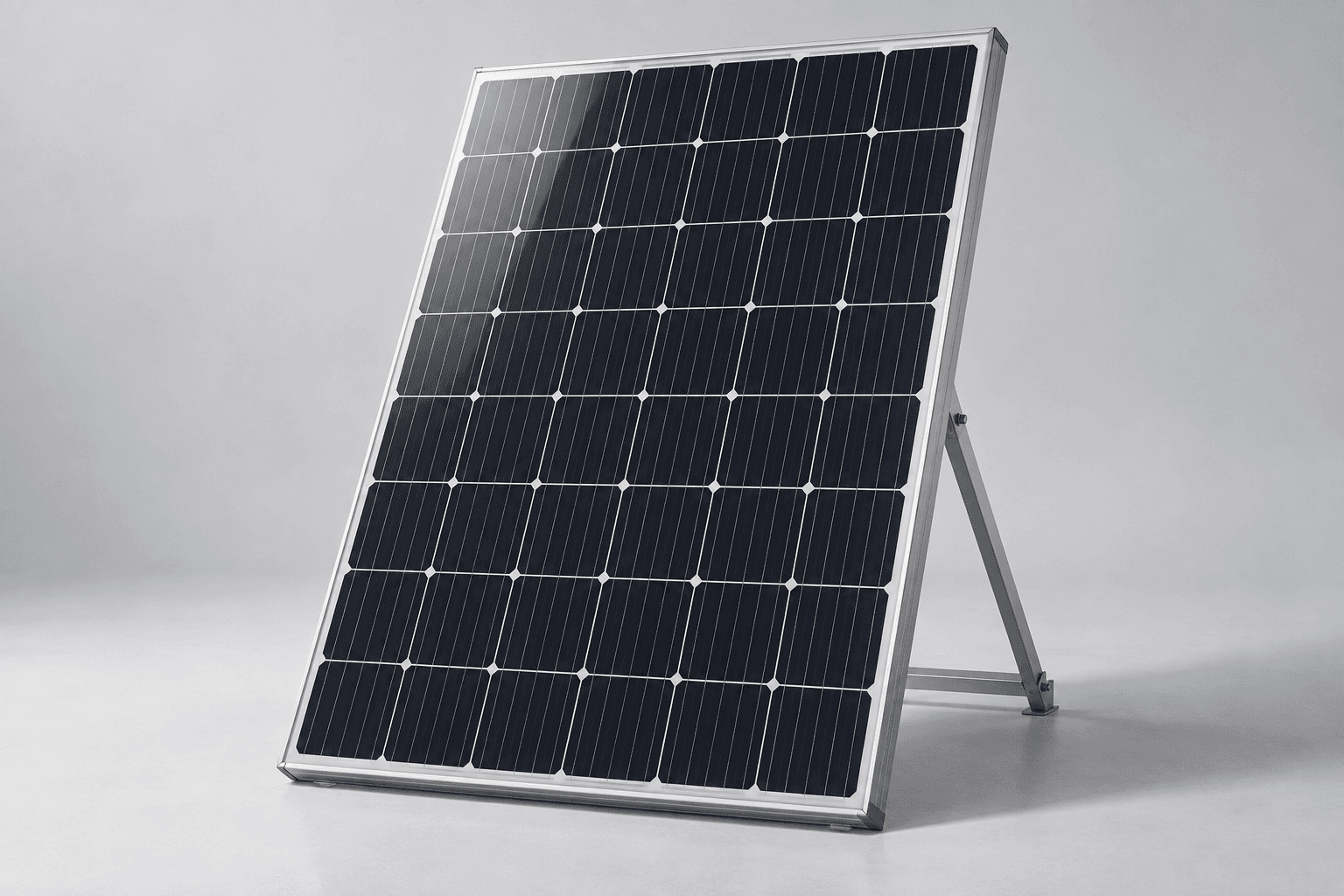
Solar panel sizing
Size solar from daily energy and location-specific seasonal yield. Panel wattage is a test rating, not a daily energy forecast.
Sources and methodology
Source-based desk research and explicit calculations; no hands-on testing claimed. Missing values remain unknown. Installation compatibility needs a separate assessment.
Use explicit yield assumptions
A first estimate is array W = daily Wh / peak-sun-hours / system yield factor. For 3000 Wh, 3.5 equivalent full-sun hours and 0.75 yield factor, the result is 1143 W. The factor represents chosen losses; do not subtract the same loss twice if using a forecast that already includes it. Peak-sun-hours are energy equivalents, not hours between sunrise and sunset.
Design for the month you use it
PVGIS provides location and configuration-based production information. Review monthly output for the actual tilt, orientation and intended occupied season. A summer camping array may not meet a winter cabin's demand. Nearby trees, chimneys and parked vehicles add local shading not necessarily represented in regional data. Record your design month and recovery strategy for several poor days.
Check voltage before buying
Series panel voltages add and cold cells can increase open-circuit voltage. Parallel strings add current. Check the controller's maximum PV voltage, input current and battery-side charge rating independently. A 400 W array is not automatically compatible with a charger labelled for 400 W. Use the exact panel temperature coefficient and the controller manual to validate the final arrangement.
Worked case and decision
Suppose daily demand is 3000 Wh. With an illustrative 3.5 equivalent full-sun hours and a 0.75 overall yield factor, required array power is approximately 1143 W. At only two equivalent hours with the same factor, that estimate rises to 2000 W. This sensitivity is why a summer result should not be used as a winter guarantee. Check a location-specific monthly yield source such as PVGIS, then consider local shade and mounting separately. A battery may bridge one poor day but does not generate the energy needed to recover afterwards. If the array only replaces average daily consumption, recharging after a deficit may take several days. Compare additional array capacity, reduced consumption or an alternative charging source. Finally, translate array watts into an electrically valid string arrangement using module Voc, temperature correction and controller limits; wattage division alone does not establish compatibility.
Turn the explanation into a procurement brief
Record included and excluded loads, system voltage, simultaneous power, starting demand and required duration. Keep efficiency and seasonal assumptions beside the result. Compare only documented values for the exact model; a missing catalog field means it needs verification, not that a feature exists. Ask the supplier for the manual, Romania delivery terms and warranty procedure before ordering.
After selecting components, a qualified installer should verify cables, protection, source isolation, ventilation and site conditions. Do not use a worked energy example as wiring instructions. When changing a load or battery, revisit both the energy budget and power check. A supervised operating test should confirm assumptions without exceeding manufacturer limits.
Sources and technical reading
Independent editorial explanation. Numerical examples are illustrative calculations, not specifications attributed to a product.